Clinton county property tax rates determine how much homeowners and property owners pay each year based on assessed value and local millage rates. These tax rates fund public schools, emergency services, road maintenance, and other local programs. The county calculates taxes using a set percentage of market value, which becomes the assessed value for billing. Each property tax bill shows how different levies combine to form the total charge. As a result, property taxation directly supports the services residents rely on daily.
Tax rates vary by township, city, and school district, so two homes with the same market value may owe different amounts. The main reason for this difference is the school district tax, which often makes up the largest share of the levy breakdown. Midway through the calculation process, clinton county property tax rates reflect voter-approved levies, bond issues, and local funding needs. The effective tax rate shows what a homeowner actually pays after reductions are applied. Property owners can search their parcel online to review their assessed value, millage rate, and full property tax bill details, and even use a calculator tool to estimate future payments.
How to Search Your Property Tax in Clinton County
Residents can complete a property tax lookup online using the county’s official parcel search system. The online portal allows users to search property tax, Clinton County Auditor, check property tax bill amounts, and download tax statements in just a few steps.
Official Property Search Portal URL: https://clintoncountyauditor.org/
Open the Official Website
- Go to: https://clintoncountyauditor.org/
- On the homepage, locate:
- Real Estate Search
- Parcel Search
- Property Search
- Click the property search link to open the parcel database.
Choose Your Search Method
The portal provides several ways to complete a parcel search:
- Owner name search
- Parcel number lookup
- Address search
- Advanced property tax records filter
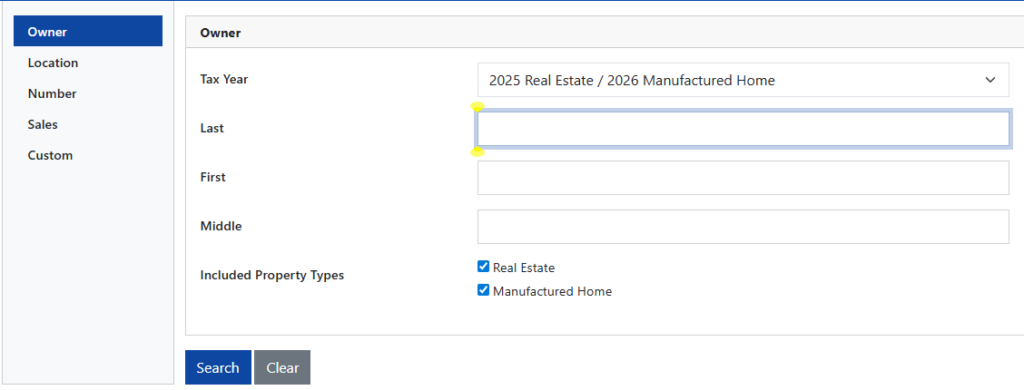
Search by Owner Name
This method works best if you know the legal property owner.
How to Search:
- Select Owner Name Search.
- Enter the last name only for broader results.
- Click Search.
- Review the list of matching property tax records.
What You Will See:
- Owner name
- Property address
- Parcel number
- Assessed value
- Current tax bill lookup
- Payment status
Click the parcel number to open full property details. The system displays tax bill history and levy information.
Search by Parcel Number
A parcel ID search gives the most accurate result. Each property has a unique parcel number.
How to Search:
- Select Parcel Number Lookup.
- Enter the full parcel number exactly as shown on your tax bill.
- Click Search.
What You Will See:
- Full assessment details
- Market value
- Assessed value (35% of market value for residential property)
- Land and building value breakdown
- Complete levy breakdown
- Effective tax rate
- Current and prior year tax bills
Search by Property Address
An address search is useful for buyers reviewing a property before purchase.
How to Search:
- Select Address Search.
- Enter street number and street name.
- Click Search.
What You Will See:
- Owner name
- Parcel ID
- Assessed value
- School district tax allocation
- Township tax rate
- Property tax bill amount
- Payment history
How to Download a Tax Statement
The portal usually provides a tax statement download option.
Steps:
- Open your parcel detail page.
- Scroll to the Tax Bill section.
- Select the current year or prior year.
- Click View or Print.
- Save the PDF copy to your device.
How to Verify Assessed Value
To confirm your assessment details are correct:
- Compare Market Value and Assessed Value.
- Confirm residential assessment equals 35% of market value.
- Review land value and building value breakdown.
- Check levy breakdown for accuracy.
- Contact the auditor’s office if corrections are needed.
What Are the Current Clinton County Property Tax Rates?
In 2026, clinton county property tax rates vary depending on township, city, and school district. Each property’s tax is calculated using the assessed value and local millage rates, which together determine the effective tax rate. These taxes fund schools, public safety, and township services, with some areas having additional voted levies that affect the total bill.
Current Tax Rates
Property taxes in Clinton County are based on millage rates applied to the assessed value of each property. The effective tax rate reflects what homeowners actually pay after adjustments, and it can differ significantly between townships, cities, and school districts.
Key Highlights:
- Property tax = Assessed Value × Millage Rate ÷ 1,000
- Average effective tax rate ~2.7% of market value
- Wilmington City has the highest average property tax bill
- Union and Liberty Townships have slightly lower millage rates
- Tax bill includes county, township, and school district levies
Here’s the current 2026 tax table for reference:
| Township / City | Millage Rate (per $1,000 assessed value) | Average Property Tax Bill* |
|---|---|---|
| Wilmington City | 85.3 | $3,755 |
| Union Township | 70.1 | $2,940 |
| Liberty Township | 68.5 | $2,870 |
| Green Township | 65.0 | $2,720 |
| Jefferson Township | 63.4 | $2,680 |
| Washington Township | 61.8 | $2,620 |
*Based on median residential assessed value of $70,000 (35% of market value $200,000).
County vs Township Tax Differences
Property tax bills in Clinton County consist of multiple components. The county tax is a flat rate applied to all properties for county services. Township or city taxes fund local roads, fire protection, and municipal services. Meanwhile, the school district tax often represents the largest portion of a homeowner’s total bill, as voter-approved levies vary by district.
Key Points:
- County tax applies to all properties equally
- Township/city tax varies depending on location
- School district tax is influenced by approved levies
- Effective tax rate averages ~2.7% of property market value
- Total tax bill = County + Township/City + School District
How Property Taxation Works in Clinton County
Property taxation in Clinton County is based on the value of your property and the local tax rates set by the county, townships, and school districts. Each homeowner’s tax bill reflects a combination of assessed value, millage rates, and approved levies, ensuring local services like schools, roads, and public safety are funded.
Assessed Value vs Market Value
The property tax system begins with two key numbers: market value and assessed value. Market value is an estimate of what a property would sell for under normal conditions. The county auditor applies a percentage to this value—known as the assessed value—which becomes the basis for calculating property taxes.
- Taxable value: The portion of a property’s value subject to taxation
- Property assessment process: Determines the assessed value using county appraisal standards
- Assessed value for residential property in Ohio is typically 35% of market value
What Is a Millage Rate?
A millage rate, or mill rate, is the amount of tax charged per $1,000 of assessed property value. Each mill represents $1 of tax per $1,000 of assessed value. This figure is used along with levies to determine the total property tax owed.
How it works:
- 1 mill equals $1 per $1,000 of assessed value
- Tax levy calculation: Multiply the millage rate by assessed value ÷ 1,000
- Mill rate formula: Tax = Assessed Value × Millage Rate ÷ 1,000
What Determines Your Final Tax Bill?
The final property tax bill combines several components, each representing a different local taxing authority. Homeowners pay taxes to the county, their township or municipality, and the school district. Voter-approved levies for parks, libraries, or fire services may also appear.
- County levy: Supports county-wide services
- Municipal/township levy: Funds local roads, safety, and municipal programs
- School district tax: Often the largest portion of the total bill
- Levy breakdown: Shows how much of the total tax goes to each authority
Clinton County Levy Breakdown
A levy breakdown shows how a property tax bill in Clinton County is divided among different local authorities. Each levy represents a portion of your taxes allocated to schools, emergency services, infrastructure, and county programs. Understanding the breakdown helps homeowners see exactly where their tax dollars go.
School District Tax Rates
The school district tax is the largest portion of most property tax bills in Clinton County. It funds local schools, teacher salaries, educational programs, and building maintenance. Each school district has different millage rates based on voter-approved levies and the district’s funding needs.
Key Points:
- Applied to the property’s assessed value
- Supports general operating funds, bond issues, and emergency levies
- Higher millage rates occur in districts with larger budgets or new school bonds
- Visible as a separate line item on the property tax bill
Township and Municipal Tax Rates
Local townships and municipalities collect property taxes to fund community services like fire protection, road maintenance, parks, and administration. The township tax rate or municipal tax varies depending on location and voter-approved levies.
Key Points:
- Township or city sets millage rates within county guidelines
- Determines the local tax burden for residents
- Townships with more infrastructure or services may have slightly higher rates
- Appears on the tax bill as a distinct portion separate from county and school taxes
County-Level Levies
County levies fund broader services that affect all residents, including the sheriff’s department, courts, health programs, and emergency management. The county levy applies uniformly across Clinton County.
Key Points:
- Contributes to public services funding across the county
- Generally smaller than school or municipal taxes but essential for county operations
- All property owners pay the same county levy rate per $1,000 of assessed value
- Shown on the tax bill with the specific millage rate and total amount
Effective Tax Rate Comparison (Clinton County vs Ohio)
The effective tax rate shows the percentage of a property’s market value that a homeowner pays in property taxes each year. Comparing Clinton County to the Ohio state average helps residents understand how their local tax burden aligns with statewide trends. Clinton County’s effective rate is slightly above the state average, mainly due to local school district levies and township taxes. This comparison highlights the differences in funding priorities across counties and municipalities.
Effective Tax Rate Comparison Table
| Location | Average Effective Tax Rate | Notes |
|---|---|---|
| Clinton County | 2.7% | Includes county, township/municipal, and school district levies |
| Ohio (State Average) | 1.98% | Based on statewide residential property data |
Property Tax Rates by City & Township
Property taxes in Clinton County differ depending on the city or township in which a property is located. Local district tax rates and municipal property tax levies create variations in the total annual tax owed, even for homes of similar market value. Understanding these differences helps homeowners and buyers estimate their expected tax burden.
Wilmington Property Tax Rates
Wilmington, as the county seat, has slightly higher taxes compared to surrounding townships due to municipal services and school funding needs. Residents here contribute to city services, the county, and the school district.
Highlights:
- City and school district taxes form the largest portion of the bill
- Local millage rates include city, county, and school levies
- Annual property tax bills reflect combined district and municipal taxes
Major Township Comparison
Townships outside Wilmington generally have lower municipal taxes but still contribute to school and county levies. Comparing the major townships shows how local millage rates affect overall property costs.
Highlights:
- Union Township and Liberty Township have moderate rates for municipal and school taxes
- Green, Jefferson, and Washington Townships have slightly lower local levies
- Differences largely stem from school district funding and township services
Property Tax Rate Comparison Chart
| City / Township | School District Tax | Township / Municipal Tax | County Tax | Total Millage Rate |
|---|---|---|---|---|
| Wilmington City | 50.2 | 20.1 | 15.0 | 85.3 |
| Union Township | 48.0 | 15.1 | 7.0 | 70.1 |
| Liberty Township | 46.5 | 15.0 | 7.0 | 68.5 |
| Green Township | 44.0 | 14.0 | 7.0 | 65.0 |
| Jefferson Township | 43.0 | 13.4 | 7.0 | 63.4 |
| Washington Township | 42.0 | 12.8 | 7.0 | 61.8 |
How to Calculate Your Clinton County Property Taxes
Homeowners in Clinton County can calculate property tax using the assessed value of their property and the local millage rates. Understanding the millage rate formula helps estimate annual taxes, plan finances, and compare tax bills across districts. Accurate calculation considers school district levies, township or municipal taxes, and county levies. Residents can use either a manual formula or the county’s online tax estimator for convenience.
Steps to Manual Formula
Calculating your property tax manually involves a few clear steps using the assessed value × millage rate method.
- Find your assessed value – typically 35% of your property’s market value for residential homes.
- Identify the total millage rate – sum of county, township/municipal, and school district rates.
- Apply the millage rate formula:
Property Tax = (Assessed Value × Total Millage Rate) ÷ 1,000
Example:
- Market Value: $200,000
- Assessed Value (35%): $70,000
- Total Millage Rate: 70 mills
- Tax Bill = (70,000 × 70) ÷ 1,000 = $4,900
Key Points:
- Include all applicable levies for a complete estimate
- Effective tax calculation may differ slightly due to credits or exemptions
- Manual calculation helps understand how each component contributes to your bill
Using the Online Tax Estimator Tool
For convenience, Clinton County provides an online property tax estimator, which simplifies calculations. Users can enter their parcel number, address, or owner name to get a precise tax bill estimate.
Benefits of Using the Tool:
- Automatically includes all applicable levies
- Shows county, township, and school district breakdown
- Generates an accurate annual tax amount without manual math
- Supports comparison across properties or districts
Property Tax Exemptions & Reductions
Clinton County homeowners may qualify for several programs that lower their property tax bills. These programs provide a property tax reduction by applying exemptions, credits, or special valuations for eligible properties. Reductions are available for primary residences, seniors, veterans, and agricultural land. Understanding these programs can help property owners plan for tax savings and ensure they pay only what is required under local and state laws. Applying for these exemptions typically requires documentation and approval from the auditor’s office, but the financial benefits can be substantial, especially for long-term homeowners or working farms.
Homestead Exemption
The homestead exemption helps homeowners reduce taxable value on their primary residence. This program is aimed at seniors, disabled individuals, and certain veterans to ease the burden of local property taxes. It directly lowers the portion of the property’s assessed value that is subject to taxation, which can make a noticeable difference in annual tax bills.
Key Points:
- Reduces taxable value for qualified owner-occupied homes
- Available to seniors, disabled homeowners, and qualifying veterans
- Requires application and approval through the auditor’s office
- Automatically applied to future tax bills once approved
Owner-Occupancy Credit
The owner-occupancy credit further lowers property taxes for those who live in the property they own. It is a supplemental reduction that works alongside other exemptions and helps homeowners manage their local tax burden. Eligible residents must demonstrate that the property is their primary residence and may need to provide proof of occupancy.
Key Points:
- Applies only to owner-occupied homes
- Can be combined with the homestead exemption
- Reduces total property taxes owed each year
- Helps offset increases from local school or municipal levies
CAUV Agricultural Valuation
The Current Agricultural Use Value (CAUV) program reduces taxes on farmland by assessing it based on agricultural productivity rather than market value. This ensures that working farms are taxed fairly and encourages continued agricultural use of land in Clinton County. Farmers must apply annually and maintain proper agricultural records to qualify.
Key Points:
- Taxes farmland based on agricultural use value, not market value
- Significant savings for working farms
- Requires annual application and proof of agricultural use
- Helps support local agriculture while reducing the property tax burden
Tax Rollback Programs
Tax rollback programs temporarily lower taxes for qualifying properties, including owner-occupied homes and specific property types. Rollbacks adjust certain portions of the tax bill, often targeting school district or municipal levies. These programs provide short-term relief to eligible homeowners and help offset increases caused by new levies.
Key Points:
- Reduces specific portions of the property tax bill
- Applied to eligible owner-occupied homes and other qualifying properties
- Helps offset increases from school or municipal levies
- Requires application or verification through the auditor’s office
Why Property Tax Rates Change Each Year
Property tax rates in Clinton County can fluctuate annually due to changes in property values, voter-approved levies, and budget adjustments. Homeowners may notice differences in their bills each year even if their property remains the same. These changes are driven by the reappraisal cycle, local funding needs, and adjustments to millage rates set by taxing authorities.
Revaluation and Property Reassessment
Each property in Clinton County undergoes periodic revaluation to ensure the assessed value reflects current market conditions. The tax reassessment process adjusts the taxable value of homes, commercial properties, and farmland. This ensures fairness, so each property pays its proportional share of taxes based on updated market values.
Key Points:
- Conducted every few years as part of the reappraisal cycle
- Adjusts assessed value to reflect current market value
- Can increase or decrease tax liability depending on local property trends
- Forms the foundation for calculating the new effective tax rate
Voter-Approved School Funding
Local residents vote on school district levies, which are a major factor in property tax rates. When voters approve a new levy or renewal, the school district tax portion of the bill may increase. Conversely, if levies expire or fail, the tax burden can decrease.
Key Points:
- School funding votes directly impact school district taxes
- Levies fund teacher salaries, school programs, and construction projects
- Homeowners see these adjustments reflected in their annual tax bills
- Ensures local schools have sufficient funding to operate
Millage Adjustments and Budget Changes
Local governments adjust millage rates to meet budget requirements for county, township, and municipal services. Even without a revaluation, changes to voted or statutory levies can alter the effective tax rate. These adjustments balance community needs with fair taxation.
Key Points:
- Millage rate changes occur to meet local budget demands
- Includes adjustments for county, township, and municipal levies
- Helps maintain funding for roads, emergency services, and public programs
- Explains why property tax rates can change annually even without new construction
How Property Taxes Fund Public Services
Property taxes in Clinton County play a critical role in funding essential public services that residents rely on every day. From education and public safety to roads and emergency response, the portion of a homeowner’s tax bill allocated to each service ensures communities remain safe, functional, and well-maintained. Understanding how taxes are distributed helps residents see the tangible impact of their contributions.
Supporting Public School Funding
A significant portion of property taxes goes to public school funding. These funds cover teacher salaries, school programs, building maintenance, and classroom resources. Voter-approved school levies determine how much each district receives, and the school district tax line on the property tax bill reflects this allocation.
Key Points:
- Funds K–12 education programs and teacher salaries
- Supports school infrastructure and maintenance
- Levy amounts are set by voters in each district
- Ensures educational standards and resources for local students
Funding Law Enforcement and Emergency Services
Property taxes also support law enforcement and emergency response services through levies like the law enforcement levy and emergency services levy. These funds help maintain police departments, sheriff’s offices, fire departments, and EMS units across the county.
Key Points:
- Supports county sheriff, local police, and emergency responders
- Fire and EMS services funded via dedicated emergency services levies
- Helps ensure rapid response times and community safety
- Levy breakdown on the tax bill shows exactly how much goes to these services
Maintaining Roads and Infrastructure
Local and county property taxes contribute to road maintenance, bridges, and other public infrastructure projects. The road maintenance tax or infrastructure levy ensures streets remain safe, functional, and accessible for residents and businesses.
Key Points:
- Funds paving, repairs, and general upkeep of township and county roads
- Supports bridges, culverts, and traffic safety measures
- Helps maintain essential infrastructure without relying solely on state funds
- Appears as a dedicated levy in the property tax statement
Historical Property Tax Trends (5–10 Years)
Over the past decade, Clinton County property taxes have gradually increased due to periodic reassessments, voter-approved levies, and changes in millage rates. While some years saw small rises, others experienced more noticeable adjustments, especially after property revaluations or new school and municipal levies. Examining historical tax rates, millage rate history, and property tax trends helps homeowners understand how their annual bills have changed and what factors influence these fluctuations.
Clinton County Property Tax Trend (2016–2025)
| Tax Year (Paid In) | Assessed Value ($) | Net Tax After Credits ($) |
|---|---|---|
| 2016 (Pay 2017) | 60,800 | 1,439.14 |
| 2017 (Pay 2018) | 63,300 | 1,481.28 |
| 2018 (Pay 2019) | 64,000 | 1,480.50 |
| 2019 (Pay 2020) | 64,200 | 1,501.76 |
| 2020 (Pay 2021) | 64,200 | 1,499.46 |
| 2021 (Pay 2022) | 64,200 | 1,481.86 |
| 2022 (Pay 2023) | 83,500 | 1,892.28 |
| 2023 (Pay 2024) | 101,800 | 2,322.56 |
| 2024 (Pay 2025) | 117,800 | 2,623.04 |
Summary of Trends
- From 2016 to 2021, property taxes remained relatively stable with minor annual changes.
- 2022–2025 show larger increases due to reassessed property values and higher school or municipal levies.
- Despite rising assessed values, net taxes are partially moderated by tax credits or rollback programs.
- Reviewing this millage rate history helps homeowners anticipate potential changes and understand the impact of local funding decisions.
Frequently Asked Questions
Property taxes in Clinton County involve multiple layers, including county, township, municipal, and school district levies. Each year, these rates can change based on property revaluations, voter-approved levies, and budget adjustments. Understanding these taxes is essential for homeowners to plan their finances, explore potential exemptions or reductions, and ensure their property assessments are accurate. The FAQs below address the most common questions with detailed, practical guidance.
What is the current property tax rate in Clinton County?
The current property tax rate varies widely depending on your location, school district, and township. For 2026, the total millage generally ranges from 60 to 85 mills per $1,000 assessed value. This includes county levies, municipal or township taxes, and school district levies. The county recently reduced its general fund millage from 3.0 to 2.5 mills, which slightly lowers taxes collected in 2026. Rates can also change due to voter-approved levies for emergency services, infrastructure, or school funding. Homeowners should check the Clinton County Auditor portal to see their specific rates.
How is millage rate calculated?
A millage rate is the amount of tax charged per $1,000 of assessed property value. To calculate your property tax, multiply the assessed value by the total millage rate, then divide by 1,000. For example, a home assessed at $150,000 with a 70-mill rate would owe $10,500 annually. Millage rates include contributions to the county, township, municipal, and school district levies. Adjustments occur each year due to new levies, reappraisals, or budget changes. Understanding how your total millage breaks down can help plan payments and identify possible exemptions or credits.
Are Clinton County property taxes high?
Clinton County property taxes are slightly above the Ohio state average, primarily because of school district levies and township services. The average effective tax rate is around 2.7%, compared to Ohio’s statewide 1.98%. While this is higher than average, taxes fund essential services like public schools, emergency services, road maintenance, and local government operations. Tax credits, homestead exemptions, and CAUV agricultural valuations can reduce the tax burden. Actual rates vary significantly by municipality and school district, so residents should review their individual property details to understand their precise obligations.
How do I search my property tax bill?
You can search your property tax bill using the Clinton County Auditor’s online portal, which is designed to be user-friendly. Searches can be done by owner name, parcel number, or property address, displaying assessed values, detailed levy breakdowns, and total taxes due. The portal also allows you to download tax statements, verify assessed values, and check payment history. This tool ensures transparency and accuracy, helps homeowners plan annual budgets, and makes it easier to review credits, exemptions, or rollback programs that may apply to your property.
What is the effective tax rate?
The effective tax rate represents the percentage of a property’s market value paid in taxes each year. In Clinton County, the average effective tax rate is about 2.7%. It is calculated by dividing your total property tax bill by the market value of your home. This metric allows comparisons between different districts or counties. Factors affecting the effective rate include school district levies, township taxes, county millage, and voter-approved levies. Programs like homestead exemptions or owner-occupancy credits can reduce the effective rate for eligible properties, making it a useful tool for homeowners to understand their true tax burden.